

Gear Stepper Motors
HIGH TORQUE · LOW SPEED · COMPACT DESIGN
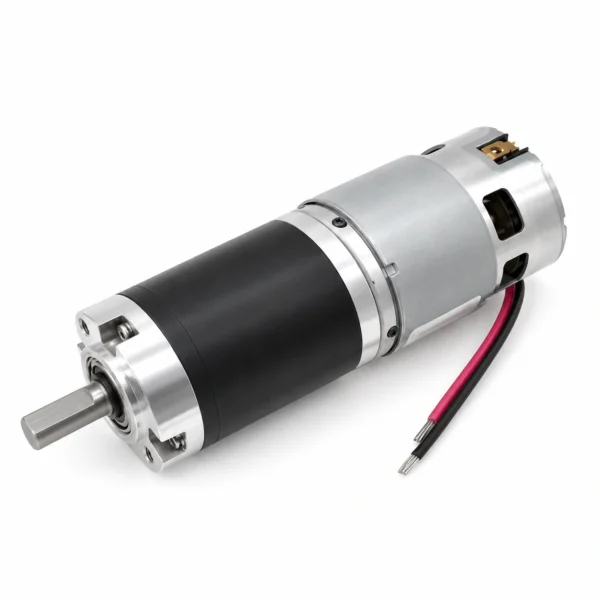
Gear stepper motors combine the precise positioning characteristics of stepper motors with mechanical gear reduction, providing higher output torque and lower operating speed for demanding motion-control applications.
Key Specifications
- Higher Output Torque
- Low-Speed Motion Control
- Compact & Integrated Design
- Stable Positioning Performance
Overview
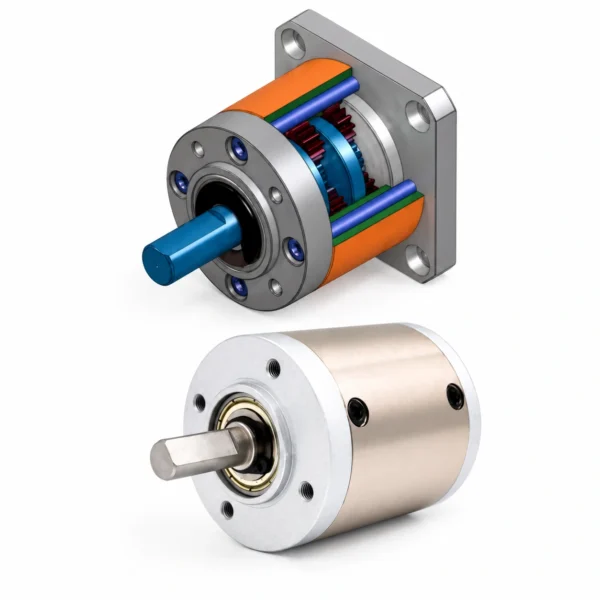
Gear stepper motors integrate a stepper motor with a reduction gearbox to increase output torque and reduce rotational speed. This configuration is useful when the application requires stronger load handling, controlled low-speed movement, or a more compact drive solution.
Compared with a standard stepper motor, the integrated gearbox provides mechanical speed reduction while increasing the available output torque at the gearbox shaft. The combination can help meet motion requirements where direct-drive stepper motors may not provide sufficient torque at the required operating speed.
Gear stepper motors are available for different automation and mechanical drive requirements. Motor size, gearbox configuration, reduction ratio, output torque, speed and installation requirements should be considered together when selecting the appropriate solution.
Key Features
Higher Output Torque
The integrated reduction mechanism increases the available torque at the output shaft, making the motor suitable for applications requiring stronger load handling.
Reduced Operating Speed
Gear reduction allows the motor to provide controlled low-speed output while maintaining the positioning characteristics of stepper motor technology.
Integrated Motor and Gearbox
The motor and gearbox are supplied as an integrated drive unit, helping simplify mechanical installation and reduce the need for a separate external reduction mechanism.
Precise Incremental Motion
The stepper motor provides controlled incremental movement, making the solution suitable for applications requiring repeatable positioning and controlled motion.
Flexible Mechanical Integration
Different motor and gearbox configurations can be selected according to the required installation space, load characteristics and motion requirements.
Applications
Gear stepper motors can be used in equipment where controlled low-speed and higher-torque movement is required.
Automation Equipment
For controlled movement of mechanical assemblies, positioning mechanisms and automated machinery.
Conveying & Material Handling
Suitable for applications requiring controlled movement and increased output torque.
Positioning Mechanisms
Used where incremental positioning and low-speed output are required.
Instrumentation Equipment
Can be integrated into compact mechanisms requiring controlled rotary movement.
Robotics & Motion Systems
Suitable for auxiliary motion axes and mechanisms requiring compact torque multiplication.
Gear Stepper Motors Range
| Configuration | Description | Typical Requirement |
|---|---|---|
| Gear Stepper Motor | Stepper motor integrated with a reduction gearbox | Higher torque and controlled speed |
| Compact Gear Stepper Motor | Compact motor and gearbox configuration | Space-limited equipment |
| High-Torque Gear Stepper Motor | Gear-reduced configuration for increased output torque | Higher-load motion applications |
| Customized Gear Motor Solution | Motor and gearbox configuration matched to application requirements | Application-specific motion systems |
How Gear Stepper Motors Work
Combining Stepper Positioning with Mechanical Reduction
A gear stepper motor combines two motion-control functions in one assembly.
The stepper motor generates controlled incremental rotation, while the gearbox reduces the motor speed and increases the available output torque. The resulting output provides slower and stronger rotary motion than the motor shaft alone.
This configuration is particularly useful when the application requires:
- Higher output torque
- Lower rotational speed
- Controlled incremental movement
- Compact mechanical integration
The appropriate motor and gearbox combination depends on the required load, output speed, installation space and positioning requirements.
How to Select a Gear Stepper Motor
Selecting a gear stepper motor requires considering both the motor and the gearbox as a complete motion system.
1. Required Output Torque
Determine the torque required at the gearbox output shaft, including the load and any acceleration requirements.
2. Required Output Speed
The required operating speed should be considered together with the gearbox reduction configuration.
3. Motor Size
Select a motor frame size that provides sufficient torque while fitting the available installation space.
4. Load Characteristics
Consider whether the application involves continuous load, intermittent operation, acceleration, deceleration or frequent positioning.
5. Mechanical Installation
Confirm the mounting dimensions, output shaft configuration and available installation space before final selection.
6. Control Requirements
The stepper motor and its driver should be matched according to the required operating current, voltage and control method.
FAQ
1. What is a gear stepper motor?
A: A gear stepper motor combines a stepper motor with a reduction gearbox. The gearbox reduces output speed and increases the available output torque, making the motor suitable for low-speed, higher-torque motion applications.
2. Why use a gearbox with a stepper motor?
A: A gearbox can provide mechanical speed reduction and torque multiplication. It is useful when a standard stepper motor cannot directly provide the required output torque or low operating speed.
3. Does a gear stepper motor provide more torque than a standard stepper motor?
A: The gearbox can increase the torque available at the output shaft through mechanical reduction. However, the actual usable output torque depends on the motor, gearbox configuration, reduction ratio, operating speed and application conditions.
4. How do I select the right gear stepper motor?
The main factors include required output torque, output speed, load characteristics, motor size, mounting dimensions and control requirements. For a specific application, these parameters should be evaluated together rather than selecting the motor based only on holding torque.
评价
目前还没有评价