

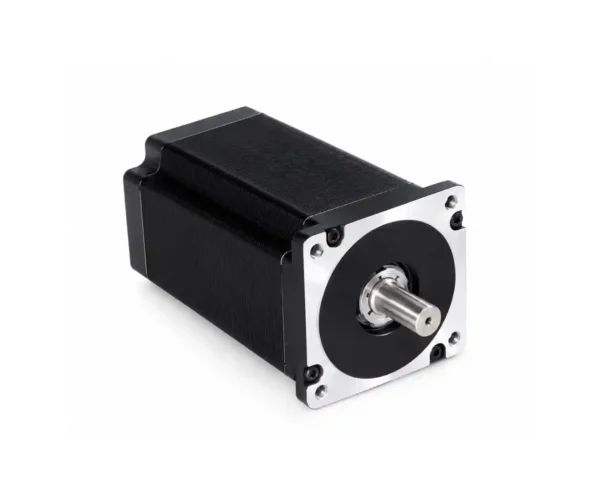
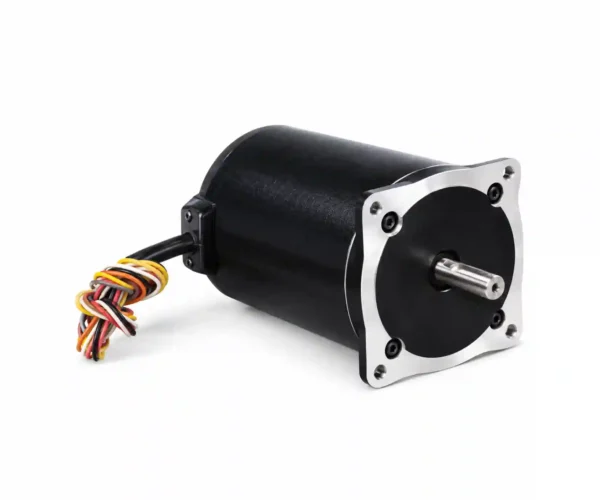
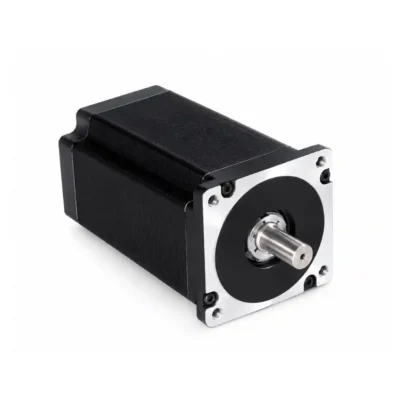
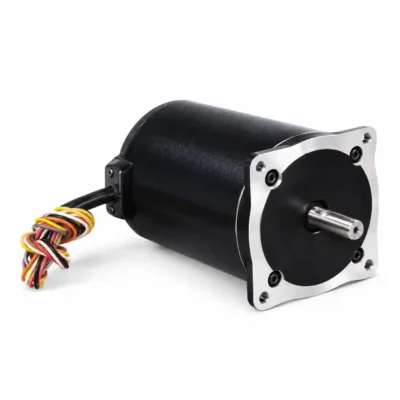
86 Series Hybrid Stepper Motor
Overview
- The 86 Series Hybrid Stepper Motor is a high-torque motor series designed for demanding motion-control applications requiring stable positioning, reliable torque output, and robust mechanical construction. The series offers multiple configurations, including different step angles, phase configurations, motor lengths, and electrical characteristics to meet a wide range of equipment requirements.
Key Specifications
- Step Angle – 1.8° / 1.2°
- Phase Configuration – 2-phase / 3-phase / 4-phase
- Step Angle Tolerance – ±5%
- Maximum Temperature – 80°C Max
- Ambient Temperature – -20°C to +50°C
- Insulation Resistance – 100 MΩ min. @ 500 VDC
- Dielectric Strength – 500 V AC, 1 minute
- Resistance Tolerance – ±10%
- Inductance Tolerance – ±20%
Overview
The 86 Series Hybrid Stepper Motor is designed for motion-control equipment that requires higher torque output and reliable positioning performance. With a larger motor frame than compact stepper motor series, the 86 Series provides multiple configurations for applications requiring increased torque and mechanical strength.
The series includes motors with different step angles, phase configurations, winding characteristics, and motor lengths. Available configurations include 1.8° and 1.2° step angles, with 2-phase, 3-phase, and 4-phase options depending on the motor configuration.
Different models provide a wide range of current, resistance, inductance, holding torque, motor mass, and overall motor length, allowing the appropriate motor configuration to be selected according to the requirements of the motion-control system.
Key Features
High-Torque Motion Control
The 86 Series is designed for applications requiring higher torque output and stable rotary positioning performance.
Multiple Motor Configurations
Different models are available with varying phase configurations, electrical characteristics, holding torque, and motor lengths, providing flexibility for different equipment designs.
Multiple Step Angles
The series includes both 1.8° and 1.2° step-angle configurations, supporting different positioning and motion-control requirements.
Robust Mechanical Design
The larger frame construction provides a solid mechanical platform for equipment requiring increased motor torque and structural strength.
Flexible Electrical Characteristics
Different winding configurations provide different current, resistance, and inductance characteristics, allowing motor selection according to the requirements of the drive system.
Suitable for Integrated Motion Systems
The 86 Series can be integrated into automated equipment and other motion-control systems where controlled positioning and higher torque output are required.
Applications
The 86 Series Hybrid Stepper Motor can be considered for motion-control applications requiring higher torque and reliable positioning, including:
- Industrial automation equipment
- Automated positioning systems
- CNC and machine tools
- Material handling equipment
- Linear motion systems
- Robotics and automation mechanisms
- Precision mechanical equipment
- Equipment requiring higher-torque stepper motor drive
Technical Specifications
The following specifications are based on the available 86 Series motor configurations. Actual values depend on the selected motor model and configuration.
General Specifications
| Parameter | Specification |
|---|---|
| Step Angle | 1.8° / 1.2° |
| Step Angle Tolerance | ±5% |
| Number of Phases | 2 / 3 / 4 |
| Maximum Temperature | 80°C Max |
| Ambient Temperature | -20°C to +50°C |
| Insulation Resistance | 100 MΩ min. @ 500 VDC |
| Dielectric Strength | 500 V AC, 1 minute |
| Resistance Tolerance | ±10% |
| Inductance Tolerance | ±20% |
Available Model Configurations
86HJB Series – 1.8°
| Model | Step Angle | Number of Phase | Current / Phase (A) | Resistance / Phase (Ω) | Inductance / Phase (mH) | Holding Torque (mN·m) | Rotor Inertia (g·cm²) | Motor Mass (kg) | Motor Length (mm) |
|---|---|---|---|---|---|---|---|---|---|
| 86HJB666-29 | 1.8° | 4 | 2.0 | 1.9 | 3.9 | 2000 | 1000 | 1.7 | 66 |
| 86HJB480-32 | 1.8° | 2 | 2.1 | 0.6 | 3.1 | 2100 | 1400 | 2.3 | 80 |
| 86HJB580-32 | 1.8° | 4 | 4.0 | 0.8 | 3.4 | 2500 | 1400 | 2.3 | 80 |
| 86HJB4118-32 | 1.8° | 2 | 4.0 | 0.5 | 0.75 | 3800 | 2700 | 3.8 | 118 |
| 86HJB118S-32 | 1.8° | 4 | 4.0 | 1.1 | 5.6 | 4000 | 2700 | 3.8 | 118 |
| 86HJB4128-30 | 1.8° | 2 | 4.0 | 0.74 | 6.5 | 6500 | 3200 | 4.1 | 128 |
| 86HJB4156-35 | 1.8° | 2 | 4.0 | 1.25 | 8.0 | 8200 | 4000 | 5.3 | 156 |
86HJD Series – 1.2°
| Model | Step Angle | Number of Phase | Current / Phase (A) | Resistance / Phase (Ω) | Inductance / Phase (mH) | Holding Torque (mN·m) | Rotor Inertia (g·cm²) | Motor Mass (kg) | Motor Length (mm) |
|---|---|---|---|---|---|---|---|---|---|
| 86HJD369H-30 | 1.2° | 3 | 1.75 | 3.77 | 11.6 | 2000 | 1320 | 2.0 | 69 |
| 86HJD369-30 | 1.2° | 3 | 2.0 | 0.5 | 0.9 | 2000 | 1320 | 2.0 | 69 |
| 86HJD397H-30 | 1.2° | 3 | 2.25 | 4.65 | 14.6 | 4000 | 2400 | 3.0 | 97 |
| 86HJD397-30 | 1.2° | 3 | 5.8 | 0.7 | 1.5 | 4000 | 2400 | 3.0 | 97 |
| 86HJD3125H-30 | 1.2° | 3 | 2.25 | 2.0 | 8.0 | 6000 | 3480 | 4.0 | 125 |
| 86HJD3125-30 | 1.2° | 3 | 5.8 | 0.9 | 2.17 | 6000 | 3480 | 4.0 | 125 |
Additional 86 Series Configurations
| Model | Step Angle | Number of Phase | Current (A) | Resistance / Phase (Ω) | Inductance / Phase (mH) | Holding Torque (N·m) | Motor Mass (kg) | Motor Length (mm) |
|---|---|---|---|---|---|---|---|---|
| 86HJB378-7313 | 1.2° | 3 | 2.0 | 1.4 | 5.5 | 1.5 | 3.8 | 77.5 |
| 86HJB460-2200 | 1.8° | 2 | 2.5 | 0.95 | 5.2 | 1.8 | 1.6 | 59.5 |
| 86HJB498-3015 | 1.8° | 2 | 6.0 | 0.78 | 3.89 | 7.0 | 4.0 | 97.5 |
| 86HJB4337-315 | 1.8° | 2 | 6.0 | 0.52 | 4.7 | 8.2 | 5.0 | 112.5 |
| 86HJB4F1-7815 | 1.8° | 2 | 6.0 | 1.06 | 10.5 | 12 | 5.8 | 150.5 |
Note: Motor performance and electrical characteristics vary by model. Please select the specific motor configuration according to the required drive and application conditions.
Dimensions & Wiring
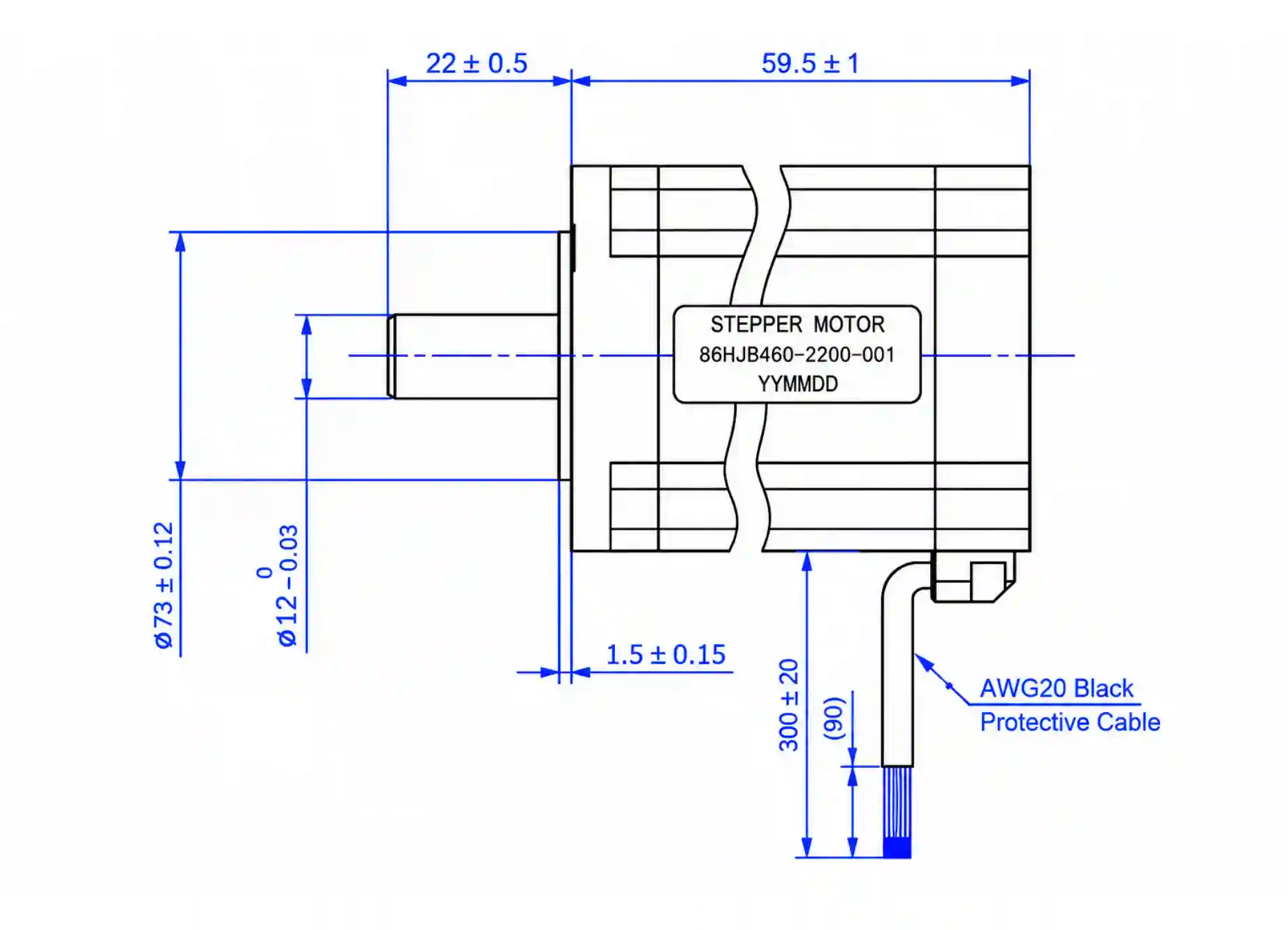
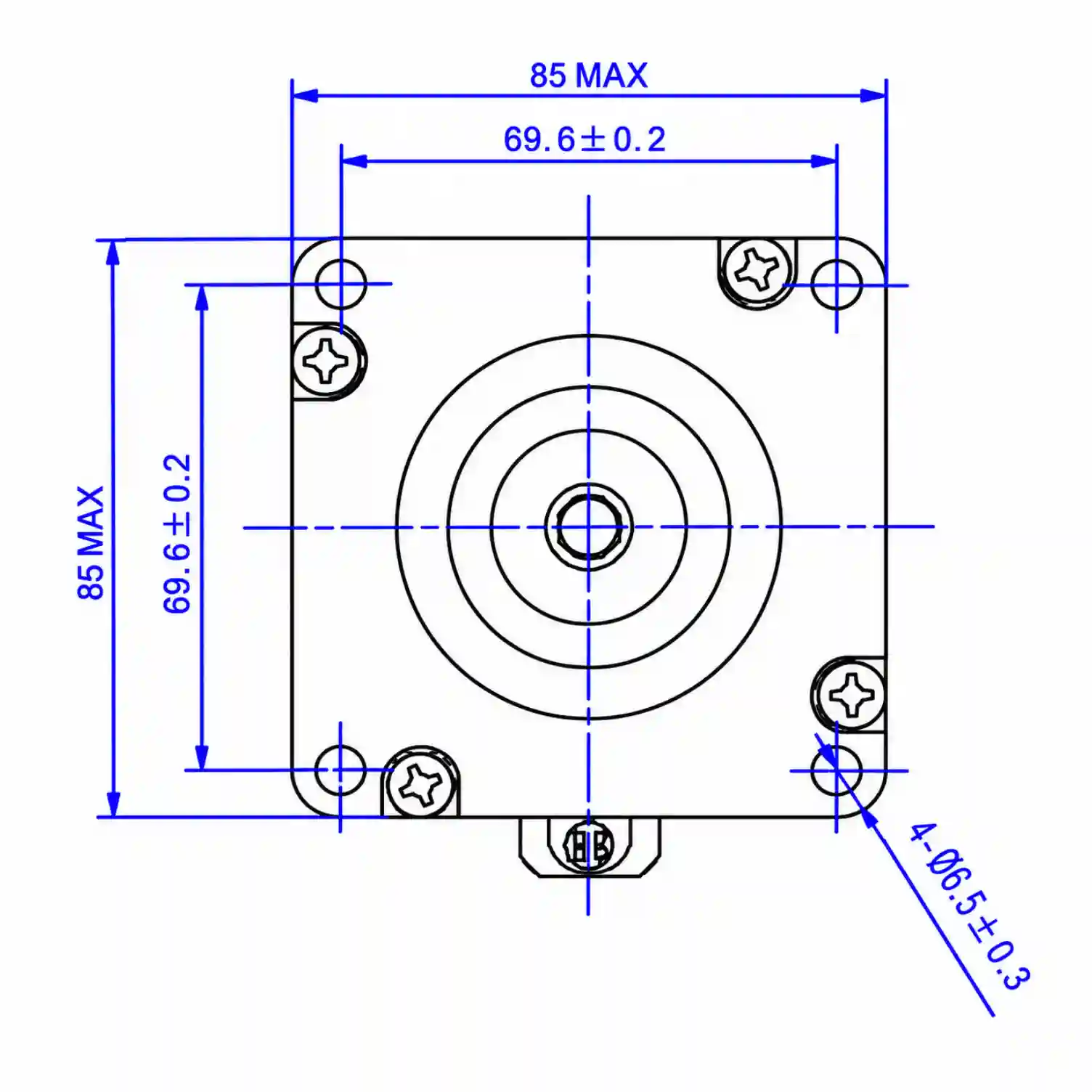
Refer to the dimensional drawings and wiring information when selecting and integrating the
86 Series Hybrid Stepper Motor into your equipment. The drawings provide key information on the motor frame dimensions, shaft dimensions, mounting holes, overall length, and wiring configuration.
The available drawings should be used together with the model specifications to confirm the required mechanical dimensions and wiring configuration before integration.
Torque-Speed Characteristics
The torque-speed curves below show representative performance characteristics of selected
86 Series Hybrid Stepper Motor models under specified test conditions. Actual torque performance may vary depending on the motor model, drive, supply voltage, current, operating speed, and other operating conditions.
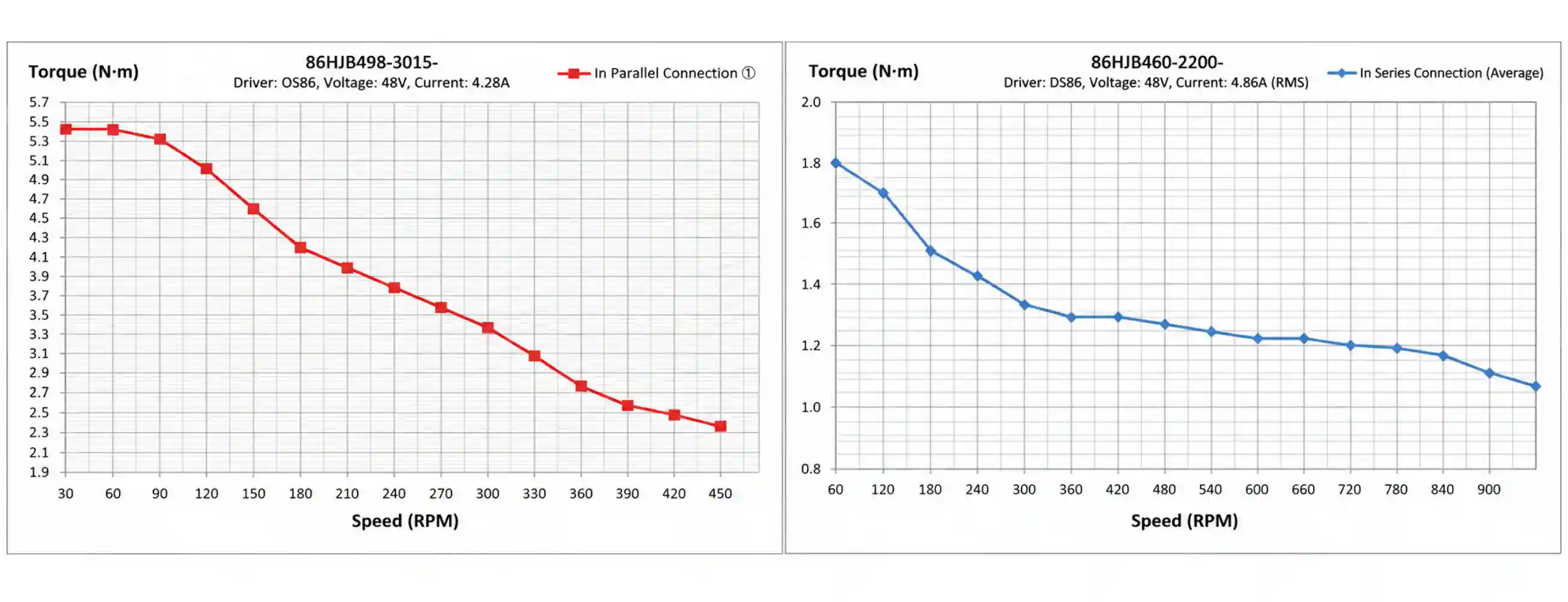
Representative torque-speed curves are provided for reference. Please contact us for detailed performance data of the specific motor model.
Why Choose the 86 Series Hybrid Stepper Motor?
Higher Torque Capability
The 86 Series includes configurations with substantially higher holding torque than smaller frame motor series, making it suitable for more demanding motion-control applications.
Multiple Electrical Options
Different current, resistance, and inductance configurations are available to match different drive systems.
Flexible Positioning Requirements
With both 1.8° and 1.2° configurations available, the series can accommodate different positioning requirements.
Model Selection Flexibility
Different motor lengths, phase configurations, holding torque levels, and rotor inertia values allow the motor to be selected according to the actual equipment requirements.
Suitable for Equipment Integration
Dimensional drawings, wiring information, and model-specific electrical data support mechanical and electrical integration during equipment design.
FAQ
1. What is the difference between the 1.8° and 1.2° step angle options in the 86 Series?
A: The 86 Series includes models with both 1.8° and 1.2° step angles. A smaller step angle provides finer incremental positioning per full step, while the appropriate configuration should be selected according to the required positioning resolution and the overall motion-control system. The available step angle depends on the specific motor model listed in the specifications.
2. Why do 86 Series models have significantly different holding torque and motor lengths?
A: The 86 Series covers multiple motor configurations with different winding parameters, motor lengths, masses, and holding torque ratings. For example, the listed 1.8° models range from approximately 1.5 to 12 N·m holding torque, with motor lengths from 59.5 to 150.5 mm. Therefore, motor length and holding torque should be considered together rather than selecting a model based on torque alone.
3. How should the different phase configurations in the 86 Series be considered during motor selection?
A: The available 86 Series models include different phase configurations, including 2-phase, 3-phase, and 4-phase configurations. Since the phase configuration is associated with different current, resistance, inductance, and wiring characteristics, the selected motor should match the corresponding drive and electrical requirements. The specific phase configuration and wiring diagram should be confirmed from the model’s technical data before integration.
4. Are the torque-speed curves applicable to every 86 Series motor?
A: No. The torque-speed curves shown on the product page represent the performance of selected 86 Series sample motors under specified test conditions. They should be used as a reference rather than as a universal performance curve for the entire series. Actual torque performance can vary with the motor model, drive, supply voltage, current, operating speed, and other test conditions. For critical applications, detailed performance data for the specific motor model should be confirmed before selection.
评价
目前还没有评价